
Saints, any good books about saints?
These saints are members of the Roman Catholic Church, through their visions and ecstatic experiences, have contributed extensively to spiritual literature. Saint Faustina a Polish Roman Catholic nun and mystic canonized by Pope John Paul II, reported frequent conversations with Jesus. She recorded visions of hell and accepted Christ’s invitation to share in His Passion. She also testified to seeing angels in every Catholic Church. At the breaking of the bread at Mass, she would see baby Jesus torn apart by the priest. Such heavenly apparitions are granted to only a few, according to God’s wisdom. In the mystical account of Anne-Catherine Emmerich, for example, it is said that at the moment of the Resurrection, only John the Apostle perceived the angel at the tomb, while Saint Peter was unaware of the apparition. These experiences emphasize the selective nature of divine revelation.
During a spiritual retreat experienced by Saint Faustina, Jesus also spoke about spiritual warfare, a subject addressed further below.

Book: Diary Of St Maria Faustina Kowalska: DIVINE MERCY IN MY SOUL by Kowalska, St. Maria Faustina
Padre Pio, a priest from southern Italy, bore the stigmata. His conversations with Jesus were casual occurrences in his life. Padre Pio's miracles include restoring eyesight to a blind woman, even though doctors could not find pupils in her eyes after the healing. He would fix legs that under the X-ray machine would show the opposite, as broken. Natural law does not apply when supernatural miracles are carried out. In confession, Padre Pio would speak foreign languages fluently and would see hidden sins in people.

Book: Padre Pio: Man of Hope by Allegri, Renzo
Saint Gemma Galgani, of Lucca, Italy, had the same discourses with Jesus as Padre Pio, experiencing the Passion of Christ many times in her lifetime and Jesus' scourging too. Her humility would drive her to doubt her sanctity until her death.

Book: The Life of Saint Gemma Galgani by Venerable Reverend Germanus C.P.
Josefa Menendez, a Spanish nun, also reported intimate conversations with Jesus. In her writings, Jesus described in detail His own Passion, offering profound insight into His unconditional love for humanity. Her work contains deeply moving prayers addressed to Mary, Jesus, and God the Father. Though largely unknown saint and marked by great humility, she is regarded as a powerful intercessor.

Book: The Way of Divine Love by Sister Josefa Menendez
Book: Jesus Appeals to the World by Sales, Lorenzo
Mary of Jesus of Agreda, another Spanish nun, in 1650, wrote Mary's life into four books: 'The Mystical City of God', from conception to coronation. Within these writings, Mary offers reflections on obedience, poverty, humility, the choice of an ordinary life, generosity toward the poor, and compassionate care for others. Her life of suffering is clearly portrayed, as is her perfect prudence in every moment. Obedience is presented as the loving submission of one’s will to another as an expression of self-giving love. Mary of Ágreda also references the sacred statue of the Virgin in Zaragoza, associated with the evangelization of Spain by the Apostle James the Greater shortly before his martyrdom in Jerusalem. She recounts that the Virgin Mary requested that her name not be emphasized in the Gospel of John, as humanity—still deeply immersed in idolatry—was not yet prepared to understand her unique relationship with God. The text emphasizes Mary’s sanctity as integral to God’s plan of redemption, underscoring humanity’s profound spiritual indebtedness to her. Mary of Ágreda further provides a detailed and moving account of the Virgin Mary’s suffering during the Passion of Christ (book quote links: 1,1,2,2,3,3,4,4).

Book: The Mystical City of God: Part One - The Conception of Agreda, Mary
Book: The Mystical City of God: Part Two - The Incarnation of Agreda, Mary
Book: The Mystical City of God: Part Two - The Transfixion of Agreda, Mary
Book: The Mystical City of God: Part Three - The Coronation of Agreda, Mary
Book: Mary: Virgin, Mother, and Queen: A Bible Study Guide for Catholics by Pacwa, Father Mitch
Book: The World's First Love by Fulton
In the writings of Catherine of Siena, her recorded conversations with God convey a profound theology of suffering and love. God makes clear that the trials inflicted upon us by our neighbor are to be received as permitted by Him, and that seeking vengeance against another is akin to directing vengeance toward God Himself. The presence of anguish, therefore, is not without purpose. Suffering becomes a means by which we learn to love our neighbor more deeply, for empathy cannot be fully cultivated without having first experienced pain ourselves.
Book: Trustful Surrender to Divine Providence: The Secret to Peace and Happiness by Father Jean Baptiste Saint-Jure
Book: The Dialogue of St. Catherine of Siena, Seraphic Virgin and Doctor of Unity by Catherine of Siena
Francis of Assisi is renowned for his profound connection to nature, perceiving both the animate and inanimate world as a living reflection of God’s creation. He demonstrated unwavering kindness to all, regardless of their sins or beliefs. Tradition holds that the development of the polio vaccine was inspired through the intercession of Saint Francis.
Book: The Lessons of Saint Francis: How to Bring Simplicity and Spirituality into Your Daily Life by Talbot, John Michael
Book: The Writings of St. Francis of Assisi by St. Francis of Assisi
Saint Anthony of Padua stands as a remarkable testimony to the extraordinary supernatural gifts granted to the saints. Among these are bilocation, miraculous healings, command over animals, intimate conversations with the Child Jesus and the Blessed Virgin Mary, raising the dead, and prophetic visions. Notably, his tongue remained incorrupt after his death, further attesting to his sanctity.
Book: St. Anthony: The Wonder-Worker of Padua by Charles Warren Stoddard
Today, there are individuals whose lives point toward eventual canonization by the Church. One such person is Fr. Zlatko Sudac, a contemporary priest, mystic, and stigmatist. His sanctity is evident in his humble submission to Church authority regarding his spiritual gifts and ministry. Fr. Sudac’s sermons are widely regarded as powerful and deeply moving. He has remarked, "It is impossible to speak about God. The only way to communicate with God is to love God...there is a fear of the Lord when we talk about Him." For this reason, I focus exclusively on Christian writings and the insights of the faithful, illustrating that Christianity remains a living and active presence today, as it has been since its inception—contrary to many portrayals in contemporary media.

Can you be a saint in the middle of family life? Yes. Jesus said to Elizabeth Kindelmann in 1963:
Let no creature come between us. Write down my words so others realize that they can only possess God if they come far away from all earthly noise. You are a living proof that this is possible. I put you in a family setting so all can see that they can serve their family and God at the same time.
Book: The Flame of Love by Elizabeth Kindelmann
A similar message was conveyed by Jesus Christ Himself to Blessed Anne-Maria Taigi, mother of seven children and incorrupt for several decades, in 1790. In addition, He imparted to her His most important counsel:
My daughter, spiritual profit consists neither in penance, nor in the frequentation of the Sacraments, nay, not even in abiding sorrow for sin, but in the union of your will with Mine. Those who wish to follow My way must renounce their own will everywhere and in all things. Do what you do not wish to do; leave undone what you wish to do; one act of violence to oneself of this kind is much more pleasing to Me than an entire year of penances. You must not for the future use such language as: 'I want this; that is pleasant, that other thing unpleasant, and I would rather not do it'-such is the language of the world.

Book: Wife Mother and Mystic: Blessed Anna Maria Taigi by Albert Bessieres
Book: St. Rita of Cascia: Saint of the Impossible by Joseph A. Sicardo
Sister Lucia of Fatima (Portugal, 1917) may further clarify the above,
How to offer Him countless little sacrifices. If you feel like eating something... leave it, and eat something else instead; and thus offer a sacrifice to God. If you feel inclined to play, do not do so, and offer to God another sacrifice. If people question you, and you cannot avoid answering them, it is God who wills it so: offer Him this sacrifice too.
Book: Fatima in Lucia's Own Words Volume I Santo, Lucia
Even non-saintly secular wisdom can shed light upon this (Ricardo Darín on the 2020 pandemic) :
We spend our lives longing for stupid things. Coronavirus is a great blow to the ego. And whenever we fight against the ego we are doing something good, because it is our internal monster.
Miracles in the life of saints are many and well documented. For example, Joan of Arc, a soldier liberating France from England, burnt at the stake in 1431,

The executioner restarted the fire so as to burn the rest of Joan's body to ashes. But Therage was unable to burn her heart and her intestines, despite the oil, the sulfur, and the charcoal he applied. He became greatly disturbed by the evident miracle and realized that he had executed a saint.
Book: For God and Country the Heroic Life and Martyrdom of St. Joan of Arc Cerrone, Fr Michael J
Related to Joan of Arc, Saint Thomas Aquinas said in 1250 about war:
Likewise to be a soldier for the sake of some worldly object is contrary to all religious life, but this does not apply to those who are soldiers for the sake of God's service.
Saint Charbel of Lebanon (May 8th, 1828-1898) healed hundreds after his incorrupt death. He is certainly looking well in the middle of this miraculous photo on May 8th, 1950,
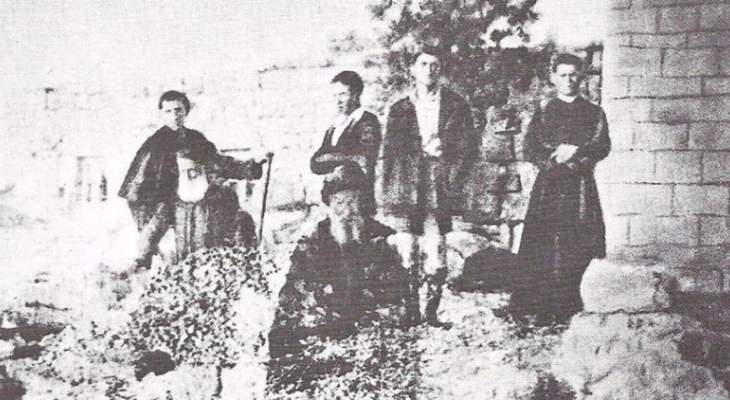
Book: Saint Sharbel, mystic of the East, 1828-1898 by Claire M Benedict
A saintly monastic life is better understood by its first pioneers, Saint Anthony of the Desert (356ac).
Book: Life of Anthony by Athanasius
The miracle of the multiplication of food is found in the life of the incorrupt Blessed John Vianney (1786 - 1859), you may read his anonymous book in audio form. Jesus' Mercy is best recognized by Margaret of Cortona (1247-1297), a penitent saint; the clearest messages from the Son of God, a wealth of information,
Book: The Life of Saint Margaret of Cortona by Antonio Francesco Giovagnoli
Saint Gabriel Possenti, a Passionist in 1860, hundreds of healing miracles occurred at his tomb.
Book: The Life of Blessed Gabriel of Our Lady of Sorrows Gabriel Possenti by Hyacinth Hage
Jesus explained about saints to a Benedict Monk, in March 2010:
Learn from My saints. Study them. Receive their teachings. Draw inspiration from their friendship with Me. But do not try to imitate them. Each of My friends arrives at union with Me by the path traced for him by the Holy Spirit. Even when two paths may appear similar, know that they are not identical. All of these paths converge in union with Me, in the light of My Face, and all of them lead to the open door of My Sacred Heart. Yours is the way of adoration. I have called you to abide before My Eucharistic Face and to make it possible for others to follow that same vocation. Even when many souls are called to the same way of life, each soul has its secret of love, a way of experiencing My friendship most intimately, that can be shared with no one else. My love is a personal love. I love each soul that I have created as if that soul were the only soul in the universe, and I adapt My infinite love to the particular sensibilities and needs of that soul with all the wisdom and tenderness of My divine Heart.
Book: In Sinu Jesu: When Heart Speaks to Heart - The Journal of a Priest at Prayer by A Benedictine Monk