
The Passion of Christ, do we know more?
Beyond the accounts found in the Gospels of the Bible, what additional insights do we have regarding the Passion of Jesus?
Book: Ignatius Catholic Study New Testament-RSV by Ignatius Press
We have a wealth of information from multiple sources that allows us to reflect on the Passion of Christ from various perspectives: that of Mary, of Jesus Himself, and of the witnesses.
Julian of Norwich, a renowned mystic, provides a vivid and intimate description of Jesus' suffering during His three hours on the cross. Her detailed account of His body exhaustion and His discoloration is heart-wrenching. Similarly, the stigmata experienced by Saint Gemma of Lucca, Italy, suggests that Jesus’ feet were placed left over the right on the cross, pierced by a single nail, and a thorn cap on His head. In these details, the film The "The Passion of the Christ" accurately reflected aspects of the historical and mystical tradition.

Book: Revelations of Divine Love by Julian of Norwich
According to Blessed Emmerich's visions, Jesus was severely mistreated after his arrest at Gethsemane (Mount of Olives), on his walk to Caiaphas' home. The book "The Boy Who Met Jesus" (Rwanda) indirectly describes the physical abuse Jesus endured during His nocturnal imprisonment and Passion. This account aligns with Mary of Agreda’s description of the prison assault, while additionally emphasizing the intercessory role of the Virgin Mary, whose intervention is portrayed as preventing indecent harassment by the guards, thereby averting sexual assault, prior to the scourging and crucifixion. Such inhumane treatment is not mentioned in the Gospels. After all this, Jesus was scourged, as described by Mary of Agreda and Blessed Emmerich in horrific detail. Saint Bridget (1360) may add: "He was then dragged along the ground and thrown down so cruelly and violently that it knocked his head about and broke his teeth. He was struck on his neck and cheek so forcefully...then scourged with barbed whips. The barbs caught in his skin and were then pulled backward, not just tearing but plowing into him so as to wound his whole body...for his body was naked during the scourging... I[Jesus] received 5480 blows on My Body." In depicting these events, the film 'The Passion of the Christ' remains remarkably consistent with these historical and mystical accounts.

Book: The Boy Who Met Jesus: Segatashya Emmanuel of Kibeho by Ilibagiza, Immaculee
Most of the left shoulder was shredded to pieces. Less than half His hair remained after the scourging, while a thorn from the Crown perforated His eye (source: 03/30/76 exorcism). The carrying of the Cross left a chasm on His right shoulder. Jesus said to Saint Margaret Alacoque in 1674: "When I was carrying My cross, I did not change it from side to side." Jesus said to Saint Bernard in 1140: "I had on My Shoulder, while I bore My Cross on the Way of Sorrows, a grievous Wound which was more painful than the others and which is not recorded by men." Jesus' shoulder wound was suffered by Saint Padre Pio (1887-1968) as a stigma that not many people know about, and it was the most painful of all his wounds. When meditated on, the veneration of Jesus' wounded shoulders brings with it unexpected graces. Saint Bridget in 1360 may add: "Then the crown of thorns was pushed down on his head so hard that it came down to the middle of his forehead. Streams of blood poured down from where the thorns sat and filled his face, hair, eyes, and beard so that almost nothing at all but blood could be seen. He could not even see me[Mary] standing there by the cross without blinking to get rid of the blood."
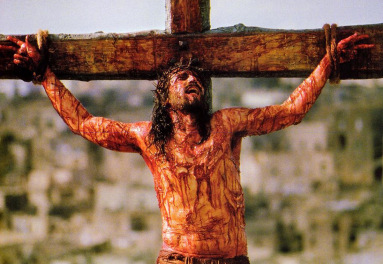
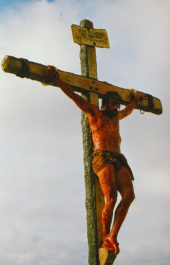
In the Garden of Gethsemane, Jesus experienced the agony of sweating blood for the redemption of our sins, as recorded in the Gospels. Blessed Anne Catherine Emmerich provides a detailed account, in which God describes the depth of His suffering at that moment:
The Lord passed in review all the future suffering of the ...church... he saw heresies and schisms entering her fold, and the sin of Adam repeated by pride and disobedience in all forms of vanity and delusive self-righteousness...the deceptive subtlety of all proud teachers; the sacrilegious crimes of all wicked priests with their frightful consequences... the pretended reformers... each wanted to have a Redeemer other than he who had delivered himself through love... Jesus saw them abandoning his wounded Church like faithless children... pitching their tent far away from the true vine, wandering sheep becoming prey of wolves, straying homeless, driven by changing winds; but they would not see the house of the Church, built upon a rock...promised until the end of time, against which hell shall never prevail...they would not enter through the narrow gate...they built upon the sand perishable huts of all kinds, without altar or sacrifice, to which their doctrine were ever changing... intoxicated with self-esteem... declaring the church of the Word made flesh is invisible.
Perhaps the most unimaginable suffering: a sinless soul bearing the weight of all the sins of humanity—past, present, and future—experiencing a temporary separation from His Father. Saint Catherine of Bologna reflected on this in 1450, saying:
His only Son, when, at the point of a painful and bitter death, he cried out, saying: "Father, why have you abandoned me?" (Mt 27.46). This happened because the divine, united inseparably to Him, really abandoned the human and sensitive part in His nature. This was the aim of justice, so that the painful obedience of Christ (Ro 5.19) would cancel the pleasure of the disobedience of our first father.
Book: The Seven Spiritual Weapons: by Catherine of Bologna
The Dereliction on the Cross is magnificently explained by Archbishop, Cardinal Henry Edward Manning. Please read this 5-page gem at this link.
Jesus revealed it was the most painful amid the last twenty minutes before expiring. To bring this agony and His Passion into perspective, it would be like seeing a family member being murdered; grab that pain, and multiply it by 10+ billion human lives. Each one of us, as loved family members of Jesus (Son of our Creator in the Trinity), has to be redeemed, otherwise, cast to hell for his/her sins (moral wrongs done for self-love). Jesus places His suffering as a ransom for us. Proud sinners scorn this gift, His mercy, because they need to acknowledge their sins. The exchange of acknowledged sins for His ransom is done at Church, through confession. Saint Gemma Galgani of Lucca likewise experienced the agony of sweating blood, sharing in the burden of blasphemies and sins committed by others. Her example underscores the importance of true contrition and heartfelt repentance for one’s sins.
Who is going to cast people into hell? People themselves, their self-love in their hearts, will guide them. Consider our response to those in need: when encountering a poor person, do we think, “Life has dealt him a hard hand; I must offer help,” or do we dismiss him with, “He is poor for a reason; ignore him”? Similarly, when passing a church, do we reflect, "I'll be there next Sunday to pray," or do we think "Church is for ignorant people; I will avoid their works"? This same love decides where the soul goes. From a world with time and matter to a place where there is no time, matter, or do-overs.
Book: The End of the Present World and the Mysteries of Future Life by Arminjon, Charles
Book: Augustine: On the Trinity Books 8-15 by Augustine
That is, who up to the present hour when the judgment is come, though ye have not the opportunity, yet retain the desire of sinning. For death separates the soul from the body, but changes not the purpose of the heart. (Catena Aurea, Aquinas)
But let Jesus Himself explain the above to a Benedict Monk on Monday, March 16, 2009:
For those who have closed their hearts to Me, rejected My intimate friendship, and withdrawn into the comfortable life they have organized for themselves-but that sort of life apart from Me is the beginning of damnation, the beginning of that hell that is not something I inflict on souls but, rather, the state in which they put themselves by withdrawing little by little from Me until, in the end, the separation is complete and there is no return.
Book: In Sinu Jesu: When Heart Speaks to Heart - The Journal of a Priest at Prayer by A Benedictine Monk
Jesus' Passion is a new covenant between God and us, a wedding ceremony. Jesus is the bridegroom, the bride is His Church, included in His Church are its members... added to his Church by baptismal waters (like a Jewish nuptial bath). His Church will be presented to the Father and Creator, at the end of times, as a bride. Better explained in the following book,
Book: Jesus the Bridegroom: The Greatest Love Story Ever Told by Brant Pitre
To only one saint Jesus has ever revealed His spiritual suffering at Gethsemane; Jesus said this to the saint Anne-Catherine Emmerich. All her vision notes (38 volumes) were released in 2009; a full account of Jesus' suffering at Gethsemane is in the book below:
A striking account, remarkable both for its prophetic clarity and its relevance to our times.
We also have more information from odd sources; let's look at Saint Clare of Montefalco heart from 1308,

A drawing was made of the saint's heart when taken from her deceased body,

Jesus' head is inclined toward the right arm, the loincloth is visible, the scourge, the pillar, the crown of thorns, the lance, the sponge, and the 3 nails. This miracle is made of cardiac muscle tissue. Matching most miracles experienced nowadays,

King David in the Old Testament, Douay-Rheims Bible, Psalm 21 (1000 years before Jesus' crucifixion), may add,
My strength is dried up like a potsherd, and my tongue hath cleaved to my jaws: and thou hast brought me down into the dust of death. For many dogs have encompassed me: the council of the malignant hath besieged me. They have dug my hands and feet. They have numbered all my bones. And they have looked and stared upon me. They parted my garments amongst them; and upon my vesture they cast lots. But thou, O Lord, remove not thy help to a distance from me; look towards my defence.

40AD cross. Found at Mary's Annunciation Holy House of Nazareth, Loreto.
Let's Venerable Archbishop Fulton Sheen explain the Cross, the Law Of Love, and total commitment:

The Shroud of Turin physically confirms all of the above. Dating methods agree in the assignment of the Shroud of Turin to the first century AD.

Medical-Forensic analysis reveals with complete security that the left foot was nailed on the right, and a nail on each hand,
AI gives us a glimpse of Jesus' face according to the Shroud,
